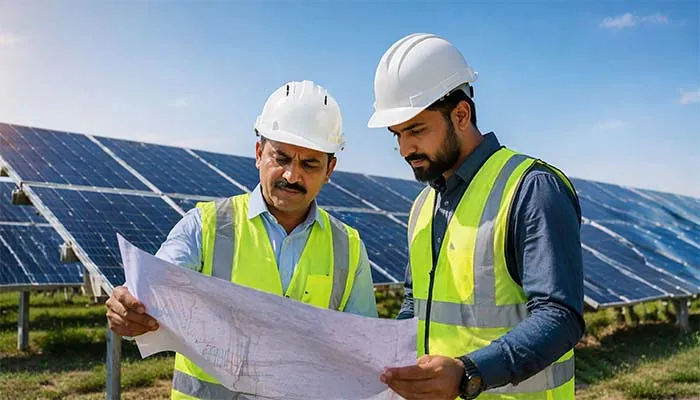

Solar energy is the better choice for most Gujarat businesses and homeowners in 2026 because it installs faster, needs no minimum wind speed, and scales down to a single rooftop as small as 50 kW. Onshore wind still wins on raw generation cost and runs at a higher capacity factor, but it needs open land, proven average wind speeds, and project scale usually above 1 MW. For rooftop, industrial, and government-scheme applications across Gujarat, solar remains the practical answer - wind stays relevant mainly for utility-scale ground projects in high-wind districts such as Kutch, Jamnagar, and Devbhumi Dwarka.
Quick definition: Solar energy converts sunlight into electricity through photovoltaic (PV) panels. Wind power converts moving air into electricity through turbine blades connected to a generator. Both are variable renewable sources - they generate only when the resource is present, unlike fossil fuel or nuclear plants that run continuously.
What Is the Real Cost Difference Between Solar and Wind Power in 2026?
Onshore wind produces electricity slightly cheaper than solar on a pure per-unit basis, but solar wins on total installed cost for most Gujarat project sizes. Global weighted-average LCOE reached USD 44 per MWh for solar photovoltaic and USD 33 per MWh for onshore wind in 2025, according to IRENA's Renewable Power Generation Costs 2025 report (July 2026). That gap narrows further once storage and grid-connection costs enter the calculation.
Wind's cost edge only applies at utility scale, though. Turbine projects rarely pencil out below 1–2 MW, while solar scales down to a single rooftop. At Raycal Power, quoted rooftop and ground-mounted systems from 50 kW upward routinely beat the entry cost of any wind alternative, simply because wind has no comparable small-project option.
Where wind's cost edge breaks down for most Gujarat buyers:
-
No small-project option - turbines rarely make commercial sense below 1–2 MW
-
Land acquisition and wind-resource studies add months to the timeline
-
Grid interconnection at 33 kV or 132 kV requires utility-scale infrastructure solar doesn't need
| 💰 Value Insight: For projects under 1 MW, cost-per-installed-kW comparisons with wind are mostly theoretical - turbine manufacturers rarely offer commercially viable units at that scale in Gujarat. |
|---|
How Reliable Is Solar vs Wind Across a Gujarat Year?
Wind turbines run at a higher capacity factor than solar panels, but Gujarat's coastal wind corridor and 300 sun-days give both technologies workable reliability. Average annual capacity factors reached 34% for onshore wind and 23% for utility-scale solar in 2024, according to a National Center for Energy Analytics review of EIA data (July 2025) - so a wind farm typically produces more electricity than a same-sized solar plant over a full year.
Gujarat's seasonal pattern favors wind from June through September, when monsoon winds strengthen along the Kutch and Saurashtra coast. Solar output, by contrast, stays fairly steady outside the monsoon, generating across the state's 300-plus sun-days a year.
Which Uses Land More Efficiently, Solar or Wind?
Wind turbines occupy a small physical footprint at each tower, but need wide spacing between units to avoid wake interference, so a wind farm's total project boundary can rival a solar park of equal output. Solar panels, by comparison, cover most of the site they sit on, leaving little room for other land uses.
That difference matters most on semi-arid land, which is exactly where most of Gujarat's utility-scale capacity sits. Our ground-mounted solar EPC projects in Amreli and Banaskantha districts typically use 4–5 acres per MW, a range that overlaps with nearby wind installations once turbine spacing is included.
Land-use factors that shift the comparison:
-
Solar covers nearly the full site - little land left for other use
-
Wind's footprint is point-based, but spacing between towers can match a solar park's total boundary
-
Agricultural land between turbines can often stay in use; land under solar panels generally can't
Maintenance, Lifespan and Total Ownership Cost
Solar systems need far less mechanical upkeep than wind turbines over a 25-year lifespan. A solar plant has one moving part worth watching - the inverter - which typically needs replacement once during the system's life. Wind turbines carry several components that all need scheduled mechanical inspection:
-
Gearboxes - the most common source of unplanned turbine downtime
-
Blades - periodic inspection for erosion and stress fractures
-
Yaw motors - keep the turbine facing into shifting wind direction
-
Towers - structural checks, especially after monsoon-season wind loading
Both technologies now carry 25-year performance warranties from major manufacturers, so lifespan itself is no longer a differentiator. The gap shows up in running cost: solar operations and maintenance typically cost less per MWh than wind O&M once mechanical wear is factored in.
"The maintenance conversation is usually where clients make their final decision," says Bhargav Bhesaniya, Director at Raycal Power. "Nobody wants to budget for gearbox replacement on a rooftop."
Which Option Fits Gujarat's Grid and Policy Landscape Better?
Solar fits a far wider range of Gujarat consumers because government schemes, net metering rules, and available land favor it at every scale. Gujarat's installed solar capacity reached 32,302.7 MW as of May 2026, more than double the state's 15,850.56 MW of wind capacity, according to Gujarat government data reported by NewKerala (July 2026).
Government support reinforces that gap. PM Surya Ghar, KUSUM Component A and B, and state rooftop subsidies all target solar specifically - wind has no equivalent household or small-business scheme. Raycal Power's guidance on Gujarat's solar subsidies covers PM Surya Ghar and KUSUM eligibility by consumer category.
| 🎯 Best Fit Scenario: If your project is a rooftop, an industrial facility, or eligible for PM Surya Ghar or KUSUM, solar is the practical route. Wind becomes competitive mainly above roughly 5 MW on open land with proven average wind speeds. |
|---|
Solar-Wind Hybrid Systems: The Emerging Middle Path
Hybrid solar-wind projects are gaining ground in Gujarat because the two resources peak at different times of day and year. Wind output tends to rise during monsoon months, while solar peaks at midday across the dry season - pairing them smooths the combined output curve.
Gujarat's renewable energy policy now allows integration of battery storage with solar, wind, and hybrid systems, making combined projects easier to connect to the grid than they were five years ago. For most consumers, though, a hybrid system only makes sense once a project clears several megawatts - below that, the added complexity rarely pays for itself.
Solar vs Wind: Which Should You Choose in 2026?
Choose solar energy if:
-
Your project is a home, rooftop, or industrial facility under roughly 5 MW
-
You want to apply for PM Surya Ghar, KUSUM, or a state rooftop subsidy
-
You need the system installed and generating within weeks, not months
Choose wind power if:
-
You control a large tract of land in a proven high-wind corridor
-
Your project clears utility scale, generally above 5 MW
-
You can absorb a longer development timeline for land, resource studies, and grid interconnection
| Factor | Solar PV | Onshore Wind |
|---|---|---|
| 2025 global LCOE | USD 44/MWh | USD 33/MWh |
| Typical capacity factor | ~23% | ~34% |
| Minimum viable project scale | Single rooftop | ~1–5 MW |
| Land use pattern | Covers full site footprint | Point towers, wide spacing |
| Gujarat installed capacity (2026) | 32,302.7 MW | 15,850.56 MW |
For most readers weighing solar energy against wind power in Gujarat this year, solar remains the practical starting point, with wind reserved for utility-scale land projects. That's the assessment Raycal Power gives most first-time clients, before any site-specific numbers come in.
Frequently Asked Questions
Can solar and wind work on the same site?
Yes. Hybrid solar-wind projects pair well because wind output often peaks when solar drops off, particularly during monsoon evenings. Gujarat's current renewable energy policy supports combined solar, wind, and battery storage connections, though hybrid setups usually only make financial sense above a few megawatts.
Is wind power realistic for homes and small businesses in Gujarat?
Rarely. Small wind turbines need consistent, unobstructed wind speeds that most rooftops and urban plots can't provide, and manufacturers offer few commercially viable units below utility scale. Rooftop solar remains the practical choice for residential and small commercial consumers.
How long does installation take for each technology?
A rooftop solar system typically installs in days to a few weeks, depending on system size and DISCOM approval timelines. Utility-scale wind projects take months to years, covering land acquisition, wind resource studies, and grid interconnection work.
Does Gujarat's monsoon season favor solar or wind?
Wind. Monsoon months bring stronger, more consistent winds along Gujarat's Kutch and Saurashtra coast, while cloud cover reduces solar output during the same period. Outside monsoon season, the pattern reverses in solar's favor.
Which technology qualifies for more subsidies in Gujarat?
Solar, by a wide margin. PM Surya Ghar, KUSUM Component A and B, and state-level rooftop subsidies all target solar specifically, while wind has no comparable household or small-business incentive program.
Do solar panels or wind turbines need more frequent repairs?
Wind turbines typically need more scheduled maintenance because they carry more moving mechanical parts - gearboxes, blades, and yaw systems. Solar systems mainly require periodic cleaning and one inverter replacement across a 25-year lifespan.