Solar Panels for Commercial Use: A Complete 2026 Guide
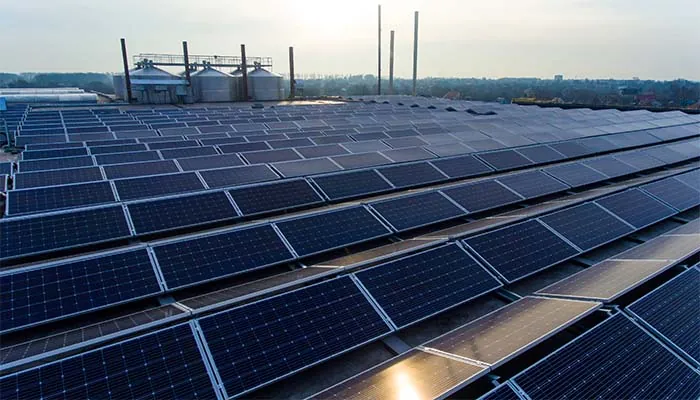
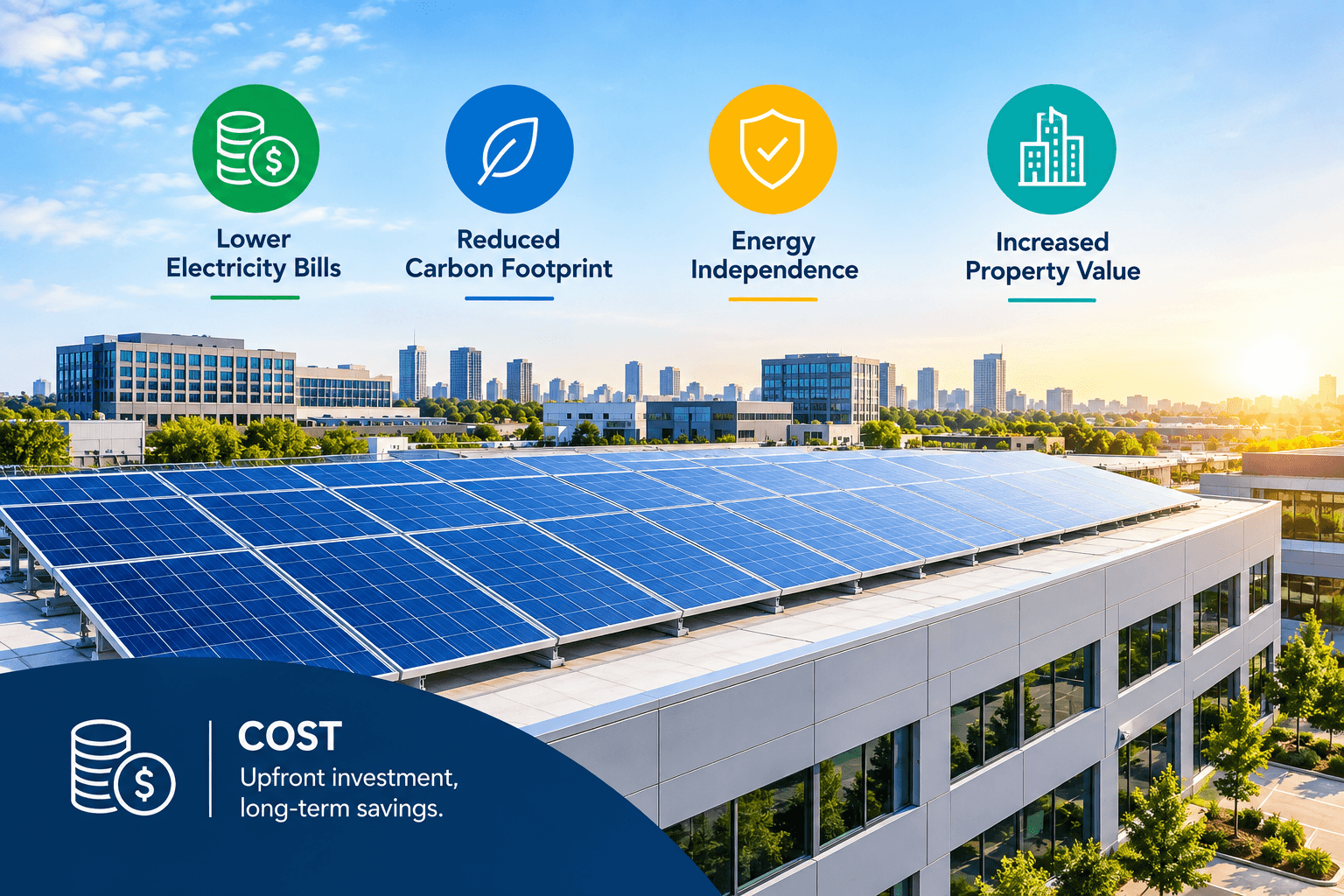
Commercial solar panels convert sunlight into electricity for factories, warehouses, offices, and institutions, usually sized between 50 kW and several megawatts. A typical commercial system in India costs roughly ₹35,000–₹45,000 per kW installed in 2026, and pays back in 4 to 6 years through bill savings, accelerated depreciation, and net metering credits. This guide covers system types, 2026 pricing, tax benefits, real payback timelines, and how to choose a solar EPC partner for your business.
| 📌 Definition Commercial solar panels are photovoltaic (PV) systems installed on business premises to offset grid electricity costs. They differ from residential systems in scale, financing structure, and eligibility for business-only incentives such as accelerated depreciation. A commercial system generally starts at 50 kW, well above the 1–10 kW range common in homes. |
|---|
What Counts as "Commercial" Solar in India?
Commercial solar refers to any system installed by a GST-registered business rather than a household consumer. This covers factories, hotels, hospitals, offices, cold storage units, and warehouses billed under commercial or industrial electricity tariffs.
Central government policy targets a cumulative 40,000 MW of grid-connected rooftop solar nationally, with commercial and industrial buyers driving an increasing share of new capacity each year. Because DISCOM tariff categories vary by state, confirm your consumer category first - it decides both subsidy eligibility and net metering rules.
How Does a Commercial Solar System Work?
A commercial system pairs solar panels with inverters and a net meter connected to the DISCOM grid. Panels generate DC power, the inverter converts it to AC, and any surplus exports to the grid for a bill credit.
Raycal Power's Gujarat installations typically use string inverters with SCADA monitoring for real-time performance tracking. This lets a facility manager check generation, consumption, and export figures from a single dashboard.
What Types of Commercial Solar Systems Are Available?
Businesses generally choose between rooftop, ground-mounted, and open-access solar. Each suits a different site profile:
-
Rooftop: Best for sites with a strong roof structure and limited land; fastest to commission on an existing building.
-
Ground-mounted: Best for businesses with spare land nearby; supports larger capacities and bifacial modules.
-
Open-access: Best for companies without rooftop or land access; power is bought from a third-party plant via the grid.
| 📌 Worth Knowing Fixed-tilt bifacial modules capture reflected light from the ground below them, adding roughly 5–10% more generation on ground-mounted sites with light-colored soil or gravel. |
|---|
A detailed comparison of ground-mounted and rooftop performance covers cost per kW, land requirements, and maintenance differences for each option in depth.
How Much Does Commercial Solar Cost in 2026?
Commercial rooftop solar costs ₹35,000–₹45,000 per kW installed in 2026, with utility-scale ground-mounted projects nearer ₹32,000–₹38,000 per kW at scale. GST on solar power generating systems was cut from 12% to 5% in September 2025, lowering commercial project costs by roughly 6–8%.
| System Size | Indicative Capital Cost | Typical Payback |
|---|---|---|
| 50–100 kW rooftop | ₹35,000–₹42,000 / kW | 4–5 years |
| 100–500 kW rooftop | ₹32,000–₹38,000 / kW | 4–6 years |
| 1 MW+ ground-mounted | ₹30,000–₹35,000 / kW | 5–6 years |
| Open-access (third-party) | No upfront capital | Immediate savings on tariff |
| 💡 Buying Tip Ask every EPC for a like-for-like quote broken down by module, inverter, structure, and installation labor - bundled quotes often hide a cheaper module tier. |
|---|
Raycal Power prices projects using Tier-1 module data sheets shared upfront, so a buyer can compare wattage, degradation, and warranty terms line by line.
What Tax Benefits and Subsidies Apply to Commercial Solar?
Commercial and industrial buyers can claim 40% accelerated depreciation on solar assets in the first year, under the Income Tax Act's renewable energy devices schedule. This is well above the 15% standard rate for general plant and machinery, and it lowers taxable income substantially in year one.
| 👨💼 Expert Advice "Most clients underestimate how much the commissioning date affects year-one depreciation," says Bhargav Bhesaniya, Director at Raycal Power. "Commission before the 180-day cutoff in a financial year, and you claim the full 40% rate instead of the reduced half-year rate." |
|---|
Direct capital subsidy programs such as PM Surya Ghar and PM-KUSUM mainly cover residential rooftops and agricultural pumps. Most commercial C&I projects instead stack three benefits:
-
40% accelerated depreciation on the solar plant, inverter, and structure in year one.
-
GST input tax credit on the 5% GST paid, recoverable in full by GST-registered businesses.
-
Net metering credits for any surplus power exported back to the DISCOM grid.
What Is the Payback Period for Commercial Solar?
A commercial rooftop system typically pays back in 4 to 6 years through combined electricity savings and depreciation-driven tax savings. Ground-mounted and open-access systems can extend to 6–7 years depending on land lease costs and grid distance.
A full payback calculation walkthrough breaks down monthly savings, depreciation timing, and O&M costs for a sample industrial rooftop project. After payback, a system with a 25-year module warranty keeps generating near-free power for 18–20 more years.
How Do You Choose the Right Solar EPC Partner?
Compare EPC bids on these factors, not price alone - a cheaper quote with a lower-tier module or no SCADA monitoring often costs more over 25 years:
-
Module tier - Tier-1 manufacturer data sheets, not just a wattage number.
-
Inverter brand and monitoring - SCADA or app-based tracking for real-time performance.
-
Structural warranty - minimum 5 years on mounting and workmanship.
-
O&M response time - a defined SLA for field response, not an informal promise.
| ⚠️ Red Flag Walk away from any EPC that won't share DISCOM interconnection experience or GEDA empanelment status in writing - both are required for net metering approval in Gujarat. |
|---|
For businesses evaluating rooftop options, reviewing industrial rooftop solar services is a useful starting point before requesting site-specific quotes. Ask for references from projects of a similar size and consumer category to your own.
Frequently Asked Questions
Is commercial solar profitable in India in 2026?
Yes, for most C&I consumers on high commercial tariffs. Combined with 40% accelerated depreciation and 5% GST, payback typically falls between 4 and 6 years, followed by 18–20 years of low-cost generation.
Do commercial solar buyers get a government subsidy?
Direct capital subsidy under PM Surya Ghar applies to residential systems only. Commercial buyers instead benefit from accelerated depreciation, GST input tax credit, and net metering, which together often outweigh a residential-style subsidy.
How many solar panels does a 100 kW commercial system need?
At current 550–600W module ratings, a 100 kW system needs roughly 170–185 panels, depending on the manufacturer and available roof or land area.
Is GST charged on commercial solar installation?
Yes, at 5% since September 2025, down from 12% previously. GST-registered businesses can claim full input tax credit, making the effective GST cost close to zero.
What warranty should a commercial solar system carry?
Look for a 25-year module performance warranty and a minimum 5-year structural and workmanship warranty from the EPC. Inverters typically carry a 5–10 year warranty, often extendable.
Can a business finance commercial solar without upfront capital?
Yes, through zero-capital OPEX models where the EPC or a third-party investor owns the plant and the business pays a fixed per-unit tariff, usually lower than the grid rate.
Final Thoughts
Commercial solar has moved from a sustainability add-on to a standard cost-reduction tool for Indian businesses. With GST at 5% and depreciation still at 40%, the financial case for 2026 is stronger than it was two years ago. Businesses that commission before their financial year's 180-day cutoff capture the full first-year tax benefit, so timing a project now sets up stronger returns going into 2027.