
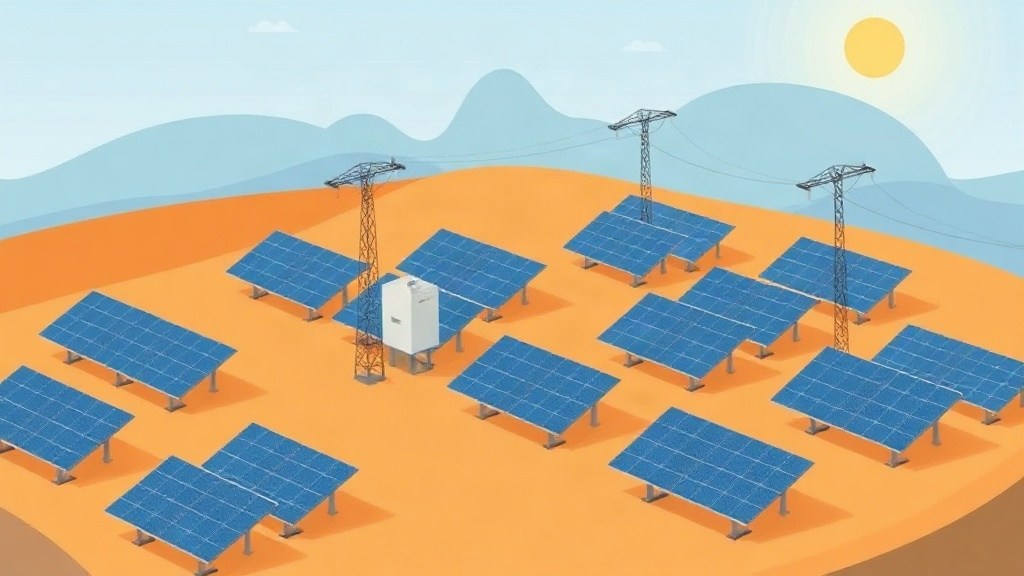
Quick Answer: A 2 MW ground-mounted solar power plant in India may cost approximately ₹7–₹9 crore as an initial planning estimate, excluding land purchase. Any price should be treated as an estimate, not a fixed quote. The final cost depends on what's included in the project, from equipment and civil work to land development and grid connectivity.
Setting up a 2 MW solar power plant in India involves five major cost components: solar modules, inverters, mounting structure, civil and electrical balance of system (BOS), and grid connection or net metering infrastructure. The final number for any project depends on module technology, site terrain, distance to the nearest substation, and whether the land is owned or leased.
Table of Contents
- 1 MW Solar Plant Cost Breakdown
- Land Requirement for 1 MW and 2 MW Plants
- ROI and Profit: 1 MW vs 2 MW
- Financing and Government Schemes
- Why Work With Raycal Power
- FAQ
1 MW Solar Plant Cost Breakdown
The cost of a 1 MW solar power plant in India gives us a useful starting point for estimating a 2 MW project. In our 1 MW solar power plant cost guide, we cover a turnkey cost range of ₹3.5–₹4.5 crore. Based on this range, you can use ₹7–₹9 crore as an initial budget estimate for a 2 MW solar power plant.
Treat this as a planning estimate, not a fixed quote. Your final cost will depend on the equipment you choose, site conditions, grid connectivity, and the scope of work included in your EPC contract.
- Solar modules (largest single cost component)
- Inverters and power conditioning units
- Mounting structure (fixed tilt or tracker based)
- Cabling, civil work, and site preparation
- Grid connection, metering, and transformer costs
The following table illustrates how an ₹8 crore project budget might be distributed. These are indicative allocations, not Raycal Power's confirmed component prices
| Component | Illustrative share | Allocation on a 8 crore budget |
|---|---|---|
| Solar Modules | 47% | ₹3.76 crore |
| Inverters | 11% | ₹88 lakh |
| Mounting structures and civil work | 17% | ₹1.36 crore |
| Cabling, transformer, and grid connection | 15% | ₹1.20 crore |
| Design, approvals, and commissioning | 6% | ₹48 lakh |
| Other costs and contingency | 4% | ₹32 lakh |
| Total | 100% | ₹8 crore |
Actual component costs can differ significantly. Module technology, foundation requirements, transformer capacity, and the distance to the grid connection point can all change the final budget. Land purchase, financing costs, taxes, and exceptional grid-evacuation work should be clarified separately in the project quotation.
A 2 MW plant may have a lower cost per MW than a standalone 1 MW installation because some design, mobilisation, monitoring, and site infrastructure costs can be shared. The savings depend on the project's layout and connection requirements.
For a more detailed look at the smaller installation, see our 1 MW solar power plant cost breakdown.
Land Requirement for 1 MW and 2 MW Plants
Land requirement for a ground-mounted solar plant depends on module efficiency, row spacing, and whether fixed-tilt or tracker-mounted structures are used. Tracker systems need more spacing between rows to avoid self-shading, while fixed-tilt systems use land more compactly but generate slightly less energy per acre over the day.
As a preliminary estimate, a ground-mounted 1 MW plant generally needs around 4–5 acres. A 2 MW plant may therefore require approximately 8–10 acres, although the actual requirement depends on the design and site.
Acres needed per MW is not a fixed number across all projects. It changes with:
- Module wattage and panel count per row
- Fixed tilt vs single-axis tracker design
- Site topography (flat vs sloped land)
- Internal roads, drainage, and fencing requirements
Can you set up a 2 MW plant on 4.5 acres? That should not be assumed without a technical assessment. A compact layout and high-efficiency modules may improve land utilisation, but usable area, spacing, access roads, and electrical infrastructure all need to be considered.
A land feasibility study should also assess shadow-free orientation, soil bearing capacity, and flood risk. These factors affect both the plant layout and the amount of civil work required.
Worth Knowing: Land feasibility studies also check for shadow-free orientation, soil bearing capacity, and flood risk, factors that affect usable area as much as raw acreage does.
ROI and Profit: 1 MW vs 2 MW
The return on a solar power plant depends on how much electricity it generates, the value of that electricity, the project's total cost, and ongoing operating expenses.
Raycal Power's 1 MW cost guide estimates annual generation of approximately 14–17 lakh units, depending on location and panel technology. Using that as a rough baseline, a 2 MW plant could generate around 28–34 lakh units annually. Actual output depends on solar irradiance, plant design, system losses, and operating conditions.
For an industrial consumer, the value of that electricity depends on the tariff it would otherwise pay. For example, at an avoided electricity cost of ₹7 per unit, generating 28–34 lakh units would represent approximately ₹1.96–₹2.38 crore in potential gross electricity savings per year.
This is an illustrative calculation, not a guaranteed saving or profit figure. The actual financial benefit depends on how much generated electricity can be used, the applicable tariff and charges, plant availability, and operations and maintenance expenses.
Solar project economics generally fall into three categories:
-
Captive consumption: The business uses the electricity to reduce its grid power bill.
-
Power purchase agreement (PPA): The project sells electricity under an agreed tariff and contract.
-
Open access: Electricity is supplied to an eligible consumer through the grid, subject to applicable regulations and charges.
A 2 MW plant may benefit from shared infrastructure compared with a standalone 1 MW plant. However, a larger capacity does not automatically guarantee a better return. The offtake arrangement, connection costs, and usable generation matter just as much.
Before committing to a project, compare the estimated generation, annual savings or revenue, O&M costs, and total project investment. A site-specific financial model is needed to calculate a realistic payback period.
Expert Advice: SCADA monitoring on a plant helps catch generation drops within hours instead of weeks, protecting monthly income by flagging underperforming strings or inverters early.
Financing and Government Schemes (PM Surya Ghar, KUSUM)
Bank financing for solar power plants may be available through term loans structured around the project's expected cash flows, power purchase agreement, or captive electricity savings. Lenders typically assess the borrower's financial position, land documentation, project feasibility, and EPC contractor's execution record.
Two government schemes that may be relevant to solar projects are PM Surya Ghar and PM-KUSUM, but they serve different purposes.
-
PM Surya Ghar: Focuses on residential rooftop solar. It should not be treated as a general subsidy for a 2 MW industrial plant.
-
PM-KUSUM: Supports eligible agricultural solar projects through different components, including grid-connected plants and solarisation of agricultural infrastructure. Eligibility and financial support depend on the specific component and applicable scheme guidelines.
A 2 MW project should be assessed against the relevant scheme rules before any subsidy or financing benefit is included in the financial model.
The cost of 1 MW under PM KUSUM depends on the specific component of the scheme applied for (solarization of agricultural feeders, standalone pump systems, or grid-connected farmer plants), since each component carries different eligibility and subsidy structures set by the scheme guidelines.
Net metering approval is a required step for any grid-connected solar plant, whether under a government scheme or a private EPC contract, since it determines how exported power is measured and credited by the distribution utility.
Grid connection requirements also need to be established early. Approval processes and applicable charges depend on the project's configuration, location, and connection arrangement.
Why Work With Raycal Power for Your 2 MW EPC Project
Raycal Power delivers Ground Mounted Solar EPC and Industrial Rooftop Solar projects for industrial, commercial, and institutional consumers across Gujarat, including service areas in Amreli, Bhavnagar, Banaskantha, Surat, and Kalawad. The team handles the full project lifecycle, from site assessment and net metering approvals through O&M contracts and SCADA monitoring after commissioning.
For farmers and residential households pursuing subsidies, Raycal Power works within PM Surya Ghar and PM KUSUM scheme frameworks to help structure applications correctly. For plant heads, operations directors, and facility managers evaluating a 2 MW ground-mounted project, the EPC process includes land feasibility review, grid connection planning, and ongoing performance monitoring after handover.
Explore the complete 1 MW solar power plant cost breakdown for a detailed look at how per-MW pricing scales as project size grows. Raycal Power has delivered over 750 MW of solar projects across Gujarat, serving industrial and institutional clients with ground-mounted and rooftop installations.
Request a site-specific quote through Raycal Power's free solar assessment to get an accurate 2 MW project cost based on your land, grid connection, and consumption profile.